Posts

ANSIBLE: Haproxy Configuration over AWS using Ansible
Image
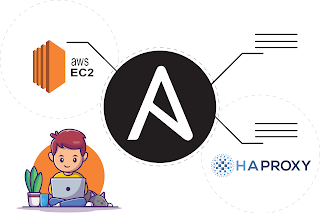
  CONFIGURATION OF HAPROXY  USING ANSIBLE OVER AWS Lets configure Reverse Proxy that is  Haproxy  using ansible Playbook. Check this blog to know more about Haproxy :  ANSIBLE : Configuration of Haproxy As every server has a hard coded limit . At one point in time, only limited clients can connect to the web server. If more clients try to connect, the will get some error. That's why we are using  Load Balancer.  Here we want to achieve  high availability  and  extra security  for our web server using haproxy. But the problem is that, if we need to add more servers, we can add them by adding their IP in inventory file and run the playbook. But  how Load balancer will come to know that more servers have been added???? For this we will have to manually update the configuration file of Haproxy. And manually updating is not good as we are using ansible. So the solution is, we can use  JINJA  language to write code in ...

Student-data-input-WebApp

Image
Create a Web-Application that takes input from users through App and consolidates all the data in excel To create this UI, we can use : > Flask for framework > HTML > Python Steps to create this UI : Step 1 : Create a HTML Form Through this form, user can insert data. This is the code for html form: And our output would be like this :   Step 2 : Create Flask code  Step 4 : Create mymenu.html file Done!! Now we can use this form to store user data in excel sheet!! GitHub URL : https://github.com/ShubhashriSinha/Student-data-input-WebApp Hope you liked my blog :)

OpenShift

Image
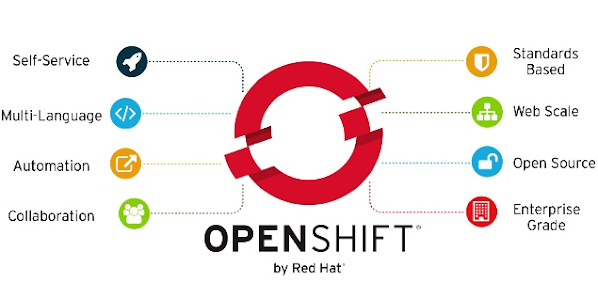
 What is OpenShift? OpenShift is an   open source   hybrid cloud   application   Platform as a Service   (PaaS) developed by Red Hat . Red Hat also offers a version of OpenShift for   private clouds   called OpenShift Enterprise .  At its core, OpenShift is an open-source tool that leverages the Kubernetes platform to manage  Docker containers  for consistent: Workload management Self-monitoring Centralized policy provisioning     With  OpenShift, developers can deploy containerized applications in an Integrated Development Environment (IDE), while employing Kubernetes to manage them. OpenShift uses Red Hat Enterprise Linux  (RHEL) and its  SELinux  (Security-Enhanced Linux) subsystem as its foundation. OpenShift supports multiple languages for ease of development, including Java, PHP, Python, Ruby, Perl and Node.js. Advantages : OpenShift is available both as:...

Jenkins

Image
     Jenkins Jenkins is an open source automation server written in Java. It is used to continuously build and test software projects, enabling developers to set up a CI/CD environment. It also supports version control tools like Subversion, Git, Mercurial, and Maven. Jenkins is well-documented and extremely extensible, with a rich ecosystem of plugins and integrations. For that reason, it excels when used in large projects that require lots of customization. While Jenkins itself is free, it must be run on a server which will need attention, updates, and maintenance. The above diagram shows the Jenkins pipeline. This includes continuous integration and continuous delivery of jobs namely the Build, Deploy, Test , and Release . It is done as these jobs are interdependent and forms the pipeline in a particular format. This involves continuous automation from one stage to another to bring down the cost, time, and number of iterations without affecting the quality. Why We Need...

Python Code on Docker Container

Image
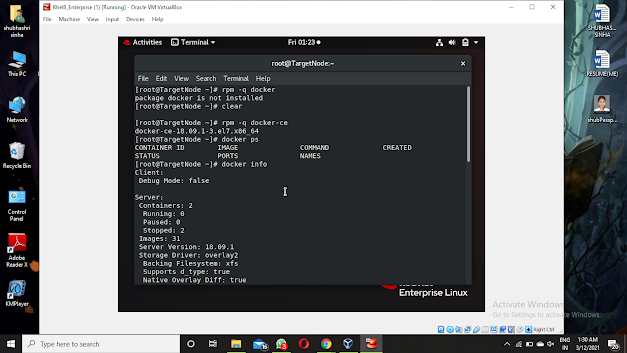
 In this blog, we are going to  Set up Python Interpreter and running Python Code on Docker Container: Step 1 : Install docker-ce on Linux OS :  Step2 : Run a container of image - centos:latest.  Step4 : Install python on that container :  Step 4 : Run python commands : We successfully  Set up Python Interpreter and run Python Code on Docker Container: Hope you liked my blog :)

Integration of LVM with Hadoop

Image
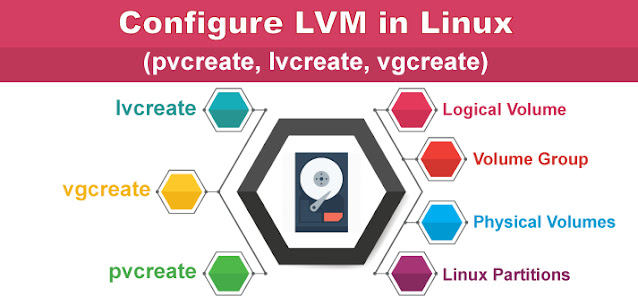
In this blog, we are going to do two things: 🔅 Integrating LVM with Hadoop and providing Elasticity to DataNode Storage 🔅Increase or Decrease the Size of Static Partition in Linux. LVM (Logical Volume Manager) Logical volume management (LVM) is a form of storage virtualization  that offers system administrators a more flexible approach to managing disk storage space than traditional partitioning. This type of   virtualization  tool is located within the device driver  stack on the operating system. It works by chunking the physical volumes (PVs) into physical extents (PEs). The PEs are mapped onto logical extents (LEs) which are then pooled into volume groups (VGs). These groups are linked together into logical volumes (LVs) that act as virtual disk partitions  and that can be managed as such by using LVM. LVM is an amazing technique using which you can  increase the storage of device on the fly , without loosing data, without shutting down the syste...

Azure Kubernetes Service (AKS)

Image
Before knowing about what is Azure Kubernetes Service (AKS), first we need to know what's kubernetes.  WHAT IS KUBERNETES ? Kubernetes is a popular open source platform for  container orchestration  — that is, for the management of applications built out of multiple, largely self-contained runtimes called  containers. Kubernetes is a  cluster management system  for managing containerized applications across multiple hosts, providing mechanisms for  deployment, maintenance, and scaling  of applications. It groups containers that make up an application into logical units for easy management and discovery. Azure Kubernetes Service (AKS) Azure Kubernetes Service (AKS) is a fully-managed service that allows you to run Kubernetes in Azure without having to manage your own Kubernetes clusters. Azure manages all the complex parts of running Kubernetes, and you can focus on your containers  Advanta ges : Pay only for the nodes (VMs) Easier cluste...