Posts

Showing posts with the label redhat

OpenShift

Image
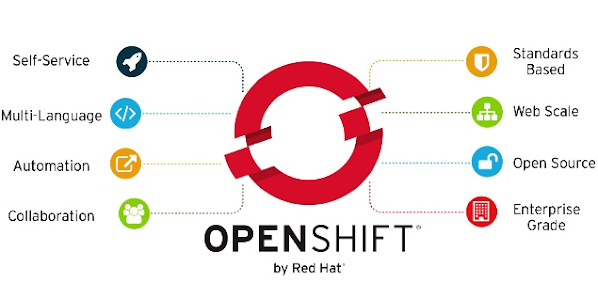
 What is OpenShift? OpenShift is an   open source   hybrid cloud   application   Platform as a Service   (PaaS) developed by Red Hat . Red Hat also offers a version of OpenShift for   private clouds   called OpenShift Enterprise .  At its core, OpenShift is an open-source tool that leverages the Kubernetes platform to manage  Docker containers  for consistent: Workload management Self-monitoring Centralized policy provisioning     With  OpenShift, developers can deploy containerized applications in an Integrated Development Environment (IDE), while employing Kubernetes to manage them. OpenShift uses Red Hat Enterprise Linux  (RHEL) and its  SELinux  (Security-Enhanced Linux) subsystem as its foundation. OpenShift supports multiple languages for ease of development, including Java, PHP, Python, Ruby, Perl and Node.js. Advantages : OpenShift is available both as:...

Expert Session on Kubernetes/ Openshift and it's Industrial usecase.

Image
  Before getting into industry, for sailing smoothly from academic to industry, it's very important have some knowledge about industry, how things works in industry, industrial use case. Just because of  Mr. Vimal Daga  sir and  Mrs. Preeti Daga  ma'am, I got this opportunity. On 01 March 2021  , they  arranged Industry Expert Practical Demo Session on Openshift/ kubernetes. Two of the best expert Redhatters of the industry  Mr. Amel Mathai  and  Mr. Daleep bais  they taught and showed use cases and industrial need. Introdution of speakers for the session, they both are Redhat experts :-  ➡️   ”Mr. Amel Mathai" (Technical Delivery Manager, Redhat Training ) "Mr. Amel is world's First Ansible certified professional and also working in Redhat from more than 12 years now." ➡️  ”Mr. Daleep Bais" (Senior Technical Instructor, RedHat Technologies) Mr. Daleep's consulting experience is primarily on Redhat's PaaS and sto...

Expert practical Demo Session on ANSIBLE and it's Industrial usecase.

Image
Before getting into industry, for sailing smoothly from academic to industry, it's very important have some knowledge about industry, how things works in industry, industrial use case. Just because of Mr. Vimal Daga sir and Mrs. Preeti Daga ma'am, I got this opportunity. On 28 Dec 2020  , they  arranged Industry Expert Practical Demo Session on Ansible. Two of the best expert Redhatters of the industry Sreejith Anujan  and Arun  Eapen CISSP, RHCA, RHCSS, RHCDS, RHCVA  they taught and showed use cases and industrial need. Lets know two of the best experts of the industry -> Mr. Sreejith Anujan & Mr. Arun Eapen .👨‍💻 ➡️ "Sreejith Anujan" ,  The Principal Instructor at Red Hat  ▪️ Primarily responsible for empowering Red Hat customers with tailor-made enablement services.  ▪️Also heading the designing and delivering high-quality content on integrated solutions and trusted partners across APAC, ANZ, and APJ. ▪️Connected with RedHat for aroun...

NETWORK TOPOLOGY

Image
In this blog I'm going to create a  network Topology Setup in such a way that System A can  ping to two Systems System B and System C but both these systems should not be pinging each other without using any security rule e.g firewall etc . Every body thinks that in a network topology, if System A can ping to B and System B can ping to C, then it's obvious that system C can ping system A. But NO, Not Always... So in this blog, I'm going to show you how to create such topology. And believe me, doing this is so simple. It's just a game of netmask and routing table. Let's jump to the practical : System A : 1. Change the ip and netmask of system A to 192.168.1.20/16 2. Then add network range in the routing table .      Here I've selected the range such that it can ping to both of my other system. 3. By using route -n command, you can check the routing table  of System. 4. Using ifconfig enp0s3 command, you can check the ip of the system . System B : 1. C...

ANSIBLE : Handlers

Image
 PROBLEM :   We all know that ansible is famous for it's  idempotency .  But if we configure some service and if we change anything in it's configuration file, then we need to restart that service.  The problem is : if configuration file is unchanged, then? Then also our ansible task will run and restart service unnecessarily. In this case, ansible is not working as idempotent. Our service will restart every time we run the playbook, even if configuration file is not updated. SOLUTION : HANDLERS We can use Handlers in Ansible to tackle this problem.  Handlers are just like a normal task. Handlers will perform an action when listens for a notify event. If nothing notifies a handler, it will not run. Regardless of how many tasks notify a handler, it will run only once, after all of the tasks completed in a particular play. To know more about ansible and it's playbook, check my this blog :  ANSIBLE : How Industries are solving Challenges using Ans...

ANSIBLE : Configuration of Haproxy

Image
  ANSIBLE Ansible  automates and simplifies repetitive, complex, and tedious operations . Everybody likes it because it brings  huge time savings  when we install packages or configure large numbers of servers. Its architecture is simple and effective. It works by connecting to your nodes and pushing small programs to them. These programs make the system comply with a desired state, and, when they have finished their tasks, they are deleted. To know more about ansible, check my this blog :    ANSIBLE : How Industries are solving Challenges using Ansible HAPROXY HAProxy is an open source, free, very fast and reliable solution offering high availability, load balancing and proxying for TCP and HTTP-based applications.  It is particularly suited for web sites crawling under very high loads while needing persistence or Layer7 processing. It distributes a workload across a set of servers to maximize performance and optimize resource usage. HAProxy can be us...