Posts

Showing posts with the label Industries

OpenShift

Image
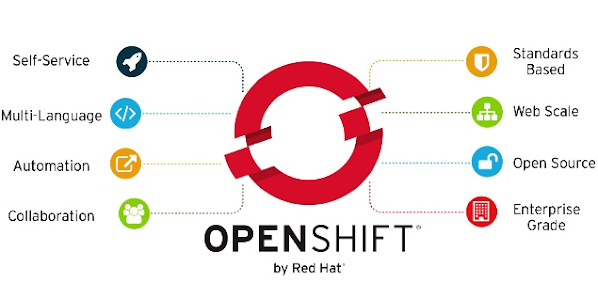
 What is OpenShift? OpenShift is an   open source   hybrid cloud   application   Platform as a Service   (PaaS) developed by Red Hat . Red Hat also offers a version of OpenShift for   private clouds   called OpenShift Enterprise .  At its core, OpenShift is an open-source tool that leverages the Kubernetes platform to manage  Docker containers  for consistent: Workload management Self-monitoring Centralized policy provisioning     With  OpenShift, developers can deploy containerized applications in an Integrated Development Environment (IDE), while employing Kubernetes to manage them. OpenShift uses Red Hat Enterprise Linux  (RHEL) and its  SELinux  (Security-Enhanced Linux) subsystem as its foundation. OpenShift supports multiple languages for ease of development, including Java, PHP, Python, Ruby, Perl and Node.js. Advantages : OpenShift is available both as:...

Jenkins

Image
     Jenkins Jenkins is an open source automation server written in Java. It is used to continuously build and test software projects, enabling developers to set up a CI/CD environment. It also supports version control tools like Subversion, Git, Mercurial, and Maven. Jenkins is well-documented and extremely extensible, with a rich ecosystem of plugins and integrations. For that reason, it excels when used in large projects that require lots of customization. While Jenkins itself is free, it must be run on a server which will need attention, updates, and maintenance. The above diagram shows the Jenkins pipeline. This includes continuous integration and continuous delivery of jobs namely the Build, Deploy, Test , and Release . It is done as these jobs are interdependent and forms the pipeline in a particular format. This involves continuous automation from one stage to another to bring down the cost, time, and number of iterations without affecting the quality. Why We Need...

Neural Networks

Image
 What is  Neural Network? Neural networks  are mathematical models that use learning algorithms inspired by the brain to store information. Since neural networks are used in machines, they are collectively called an ‘ artificial neural network .’  Nowadays, the term machine learning is often used in this field and is the scientific discipline that is concerned with the design and development of algorithms that allow computers to learn, based on data, such as from sensor data or databases.  A major focus of machine-learning research is to automatically learn to recognize complex patterns and make intelligent decisions based on data. Neural networks are a popular framework to perform machine learning, but there are many other machine-learning methods, such as  logistic regression , and  support vector machines . Similar to the brain, neural networks are built up of many neurons with many connections between them.  Neural networks have been used in m...

Expert Session on Kubernetes/ Openshift and it's Industrial usecase.

Image
  Before getting into industry, for sailing smoothly from academic to industry, it's very important have some knowledge about industry, how things works in industry, industrial use case. Just because of  Mr. Vimal Daga  sir and  Mrs. Preeti Daga  ma'am, I got this opportunity. On 01 March 2021  , they  arranged Industry Expert Practical Demo Session on Openshift/ kubernetes. Two of the best expert Redhatters of the industry  Mr. Amel Mathai  and  Mr. Daleep bais  they taught and showed use cases and industrial need. Introdution of speakers for the session, they both are Redhat experts :-  ➡️   ”Mr. Amel Mathai" (Technical Delivery Manager, Redhat Training ) "Mr. Amel is world's First Ansible certified professional and also working in Redhat from more than 12 years now." ➡️  ”Mr. Daleep Bais" (Senior Technical Instructor, RedHat Technologies) Mr. Daleep's consulting experience is primarily on Redhat's PaaS and sto...

Industrial Use Case of KUBERNETES

Image
WHAT IS KUBERNETES ? Kubernetes is a cluster management system for managing containerized applications across multiple hosts, providing mechanisms for deployment, maintenance, and scaling of applications. It groups containers that make up an application into logical units for easy management and discovery. Kubernetes builds upon years of experience at Google running production workloads at scale using a system called  Borg , combined with best-of-breed ideas and practices from the community. Google released Kubernetes in 2014, donated it as a seed technology for the founding of the  Cloud Native Computing Foundation  in 2015, and continues actively using and developing the project. Kubernetes Master The Kubernetes master is the primary control unit for the cluster. The master is responsible for managing and scheduling the workloads in addition to the networking and communications across the entire cluster. These are the components that run on the master: Etcd Storage ...